





















By Dr. Rebecca Stobaugh, Dr. Christy Bryce, and Bryan Wimmer
While working with a high-needs middle school, I observed an eager teacher begin class with a 15 question pre-assessment designed to take just five to seven minutes. Yet, twenty minutes later, she was still trying to corral students—pulling them away from friends and phones—to finish the task. Between class periods, I asked if she would be willing to try a simple experiment. As students entered the room for the next class, she asked them to remain standing until they completed the assessment; once finished, they could sit. The result was immediate. Every student completed the pre-assessment within seven minutes and was seated, focused, and ready to learn.
Why do students spend so much of their day sitting in secondary schools? Think about a typical conference experience: hours of sitting, brief moments of movement, then more sitting. Most adults leave mentally and physically drained. Now imagine that reality every day for students—expected to remain seated, quiet, and attentive for long stretches. If this model exhausts adults, why do we accept it for adolescent learners? Learning depends on capturing students’ attention and actively engaging their minds—and one of the most effective, research-based ways to do this is through structured movement. Structured movement is intentional, planned physical activity built into learning or routines with a clear purpose and expectations—not random movement or unregulated breaks.
Its impact is especially powerful for historically underserved students, including foster youth, students experiencing homelessness, and newcomer and multilingual learners. According to the 2025 California Department of Education Scorecard, these groups trail the state graduation rate of 87.8 percent by as much as 18 points. Closing these gaps demand new approaches, and movement-rich learning represents a powerful, largely untapped opportunity, particularly in middle and high schools.
This article argues that movement is not a management tool or a break from learning—it is a core design principle for equity, engagement, and achievement in secondary schools. When implemented intentionally, purposeful movement becomes a high-leverage instructional choice that directly shapes student participation, persistence, and academic outcomes.
Why Movement Works: Insights from the Research
A growing body of research underscores the powerful impact of purposeful movement on student engagement, focus, and the overall academic experience. In secondary schools that intentionally embed physical activity into core instruction, teachers consistently report noticeable increases in participation—particularly among quieter or more hesitant learners who become more willing to contribute (Ottesen & von Seelen, 2019). Movement-based learning experiences help students sustain attention for longer periods, providing a natural cognitive reset that sharpens focus during academic tasks (Masini et al., 2022; Mavilidi et al., 2022). For some students, movement also serves as an effective outlet for stress and anxiety, supporting emotional regulation alongside academic engagement (Stubbs et al., 2017; Teuber et al., 2024).
Equally important, teachers observe that shared physical activity strengthens classroom relationships by creating new opportunities for collaboration, positive peer interaction, and a more supportive learning climate. For neurodivergent students and those with underdeveloped executive functioning skills, movement has been shown to enhance memory and self-regulation—suggesting that integrating movement into instruction may also reduce behavioral challenges (Mavilidi et al., 2022). Collectively, these shifts contribute to richer, more dynamic learning experiences that extend well beyond the limits of traditional, seated instruction.
Students’ perspectives further reinforce these findings. They describe movement-enhanced lessons as “enjoyable” and “innovative,” noting that even brief opportunities to move disrupt the monotony of prolonged sitting and refresh their approach to learning. Students report feeling more alert, focused, and ready to engage in discussion after participating in purposeful movement. Beyond improved concentration, active learning contributes to their overall sense of well-being—making school feel more energizing, meaningful, and engaging. Studies reveal that small doses of movement can reshape classroom culture in ways that better support attention, motivation, and positive academic experiences (Mulhearn et al., 2023; Romar, Enlund, Lind, & Björkgren, 2023).
Given that movement is associated with increased participation, greater time on task, and stronger social connectedness—while also reducing disruptive behavior—it is striking that fewer than one in four high school students meet the recommended 60 minutes of daily physical activity (23.9%) according to the Centers for Disease Control and Prevention (2023). By intentionally integrating movement into instruction, educators can offer students a powerful double benefit: reducing stress and anxiety while significantly expanding opportunities for meaningful engagement in learning.
Movement in Action: Practical Strategies for Secondary Classrooms
While movement strategies are commonly woven into daily routines in elementary classrooms, secondary schools often rely on class transitions as the primary—sometimes only—form of movement built into the day. In 30+ Movement Strategies to Boost Cognitive Engagement (Stobaugh, 2022), the author outlines a variety of instructional strategies and content-area applications. Several practical, easy-to-integrate strategies are summarized below, along with examples of how they can be applied across content areas.
| Strategy | Implementation Steps | Content Area Examples |
| Back to Back & Face to Face |
|
Science: Choose a complex natural system—such as climate regulation, photosynthesis, or the water cycle—and analyze how one small change in a single component could trigger a chain reaction throughout the system. What evidence supports your prediction, and how might humans amplify or mitigate this impact? |
| Trip Wires |
|
Economics: What are misconceptions about inflation?
US History: What misunderstandings surround the idea that the American Revolution started just because colonists disliked paying taxes? |
| Would You Rather |
|
Math: Would you rather solve this problem using a formal mathematical model or a real-world simulation? Explain which approach provides deeper insight into the underlying patterns or variables.
Civics: Would you rather shape national policy as a Supreme Court justice or influence public opinion and leadership as the president? Justify your choice using evidence about constitutional powers and long-term impact. |
| Standing Discussion |
|
English: Choose a character whose actions seem unjustified or controversial. How does examining the story from that character’s perspective change—or complicate—your understanding of the theme or moral of the text? |
| Find An Expert |
|
Math: The task sheet features nine carefully selected problems that target different skills.
Physics: The task sheet presents nine problems that allow students to practice applying forces, motion, energy calculations, and other key physics skills. |
| Walking Classroom |
|
Science/Health: How does sleep (or the lack of sleep) affect teenage development and learning?
Personal Finance: What is the history of minimum wage laws? How do these laws affect teenagers and their families? |
| Active Observation & Inquiry |
|
English: Examine the report excerpt and the subsequent editorial.
Math: Analyze the data set, graph, and worked example. Careers: Examine the sample résumé along with the job posting. Science: Observe the phenomenon shown in the video clip |
When Space Becomes Strategy: Schoolwide Supports for Movement
Opportunities for structured movement can be woven into the very fabric of a secondary school’s design. Through the intentional use of physical regulation rooms, learning stairs, and collaboration spaces, schools can create environments that prioritize purposeful motion and support student engagement, well-being, and focus. Research on novelty and learning shows that people are more likely to explore environments that offer new stimuli—and that this exploration is linked to increased engagement and improved learning outcomes (Streubel, Thibaut, & Mackintosh, 2021). When movement is supported through intentional space design, it becomes a system—not just a strategy.
Restoring Readiness: The Power of Physical Regulation Spaces
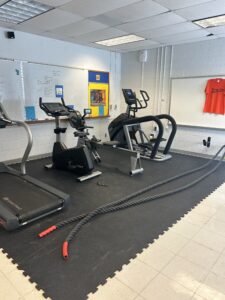
An innovative approach many schools are adopting is the creation of active self-regulation spaces equipped with tools such as punching bags, heavy ropes, yoga mats, resistance bands, and treadmills or ellipticals. These environments—often located in a separate, enclosed space—offer the physical reset some students need to bring a stressed brain back online, restoring readiness for learning and emotional balance. These spaces can be used during wellness classes, targeted movement breaks, or small-group instruction. Sample learning experiences include:
Walk-and-Talk Station: Students walk side-by-side while discussing a podcast or short video, using guiding prompts such as What did I agree with? How can I connect this to my experiences? What questions remain?
Active Learning Choice Board: Students select both a movement activity (e.g., planks, ropes, resistance bands) and a cognitive task (e.g., explain a math strategy, respond to a reflection prompt) to complete as their assignment.
QR Station Rotation: QR codes posted around the room link to short readings or videos. Students complete a brief exercise at each station, then complete the task before rotating to the next, engaging both body and mind.
Relay, Race, and Review: Teams rotate through short bursts of physical activity followed by academic challenges—solving problems, responding to prompts, or reviewing key concepts.
Learning Stairs: Elevating Collaboration and Engagement
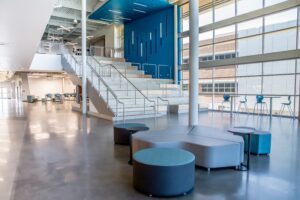
As districts invest in spaces that promote collaboration, connectivity, and student well-being, learning stairs have emerged as a powerful instructional feature. Their centralized, visible location makes them ideal for flexible grouping, cross-curricular collaboration, and multi-grade learning experiences. Instructional possibilities include:
Subject Experts: Students from advanced courses mentor peers from introductory classes, offering explanations, modeling strategies, and collaborative problem-solving.
Station Conversations: Chart paper with content-specific prompts is placed along the stairs. Small groups rotate through stations, adding insights and responding to one another’s thinking.
Climb the Question Trail: Higher-order questions are posted along the steps. Students move with a partner, discussing and recording responses as they progress.
Turning Common Spaces into Learning Places
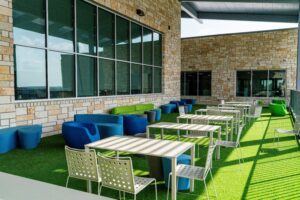
Many schools already have cafés, common areas, hallways, and outdoor learning spaces—yet these environments are often underutilized for instruction. Meanwhile, secondary classrooms remain constrained by bulky furniture and limited floor space that restrict movement. Designing learning experiences in alternative settings energizes students and opens new possibilities for engagement. When used intentionally, shared spaces become powerful extensions of the classroom rather than merely transitional zones. Effective strategies include:
Opinion Lines / Continuum Walks: Students position themselves along a line to represent their level of agreement or confidence, then justify their stance with evidence.
Line Up, Pair Up: In hallways or open areas, students form two facing lines. After each discussion round, one line shifts so students engage with new partners.
Four Corners: Each corner represents a different claim, solution, or perspective. Students move to their chosen position and build arguments collaboratively.
Claim–Evidence Match-Up: Students circulate to find peers whose cards create accurate claim-and-evidence pairings.
Error Analysis Stations: Stations present common misconceptions or flawed solutions. Students rotate, diagnose errors, and propose corrections.
These approaches encourage purposeful movement, sharpen focus, and consistently lead to higher levels of participation and engagement when students return to the classroom.
From Restless to Ready: A Call to Rethink Movement in Schools
The question is no longer whether movement belongs in secondary schools, but whether we are willing to design learning environments that reflect what we know about how students learn best. Purposeful movement is not a distraction—it is a catalyst for engagement, focus, and achievement. When students are given structured opportunities to move and interact with content, they become more attentive, better regulated, and more willing to participate, especially those facing socioeconomic challenges, language barriers, or neurodivergence.
Importantly, integrating movement does not require sweeping change. Small, intentional strategies—such as standing discussions, station rotations, and purposeful use of shared spaces—can interrupt prolonged sitting, renew attention, and deepen learning. Rethinking the role of movement offers a practical, research-informed path to move students from restless to ready.
Dr. Rebecca Stobaugh is an Innovation and Impact Learning Experiences Strategist for Meteor Education, where she partners with schools to design innovative learning environments that foster student agency and engagement. A former middle and high school teacher, professor, and instructional coach, she brings deep classroom and leadership experience to her work with districts nationwide. Rebecca has authored multiple books on critical thinking and instructional design, and she is passionate about helping educators create future-ready learning experiences that prepare students to thrive in a complex world.
Dr. Christy Bryce is the Director of KY-ABRI, a project through the University of Louisville. Her experience as a special education teacher, school psychologist, and Director of Intervention has driven her to become a dedicated advocate for students with untapped potential. Christy seeks to translate research into practice by helping schools build effective systems and incorporate best practices for students who learn differently.
Bryan Wimmer is a Learning Experience Coordinator at Meteor Education, where he partners with educators to design and support student-centered learning environments. His experience as an intervention specialist in a 3–5 emotional disabilities classroom shaped his passion for building strong relationships and student confidence. He brings that same relationship-driven approach to helping districts implement innovative learning spaces.
References
California Department of Education. (2025). California School Dashboard: Academic engagement—Graduation rate. https://www.caschooldashboard.org/reports/ca/2025/academic-engagement#graduation-rate
Centers for Disease Control and Prevention. (2023). Youth risk behavior surveillance—United States, 2021 (Morbidity and Mortality Weekly Report Supplement, Vol. 72, No. 1). U.S. Department of Health and Human Services. https://www.cdc.gov/mmwr/volumes/72/su/pdfs/su7201-h.pdf
Masini, A., Ceciliani, A., Dallolio, L., Gori, D., & Marini, S. (2022). Evaluation of feasibility, effectiveness, and sustainability of school-based physical activity “active break” interventions in pre-adolescent and adolescent students: A systematic review. Canadian Journal of Public Health, 113(5), 713–725. https://doi.org/10.17269/s41997-022-00652-6
Mavilidi, M., Pesce, C., Benzing, V., Schmidt, M., Paas, F., Okely, A. D., & Vazou, S. (2022). Meta-analysis of movement-based interventions to aid academic and behavioral outcomes: A taxonomy of relevance and integration. Educational Research Review, 37, 100478. https://doi.org/10.1016/j.edurev.2022.100478
Mulhearn, S. C., Kulinna, P. H., McLeod, C., & Yu, H. (2023). Equipping high school classroom teachers to support physical activity. Teaching and Teacher Education, 129, 104165. https://doi.org/10.1016/j.tate.2023.104165
Ottesen, C. L., & von Seelen, J. (2019). Physically active lessons in secondary school: An intervention study. Idrottsforum.org. https://idrottsforum.org/wp-content/uploads/2019/03/ottesen-vonseelen190325.pdf
Romar, A., Enlund, M., Lind, C., & Björkgren, M. (2023). Movement integration in academic classrooms: A focus on secondary students’ experiences. Journal of Physical Education and Sport, 23(4), 907–915. https://efsupit.ro/images/stories/aprilie2023/Art115.pdf
Stobaugh, R. (2022). 30+ movement strategies to boost cognitive engagement: Activating minds and bodies to maximize student learning. Solution Tree.
Streubel, B., Thibaut, J.-P., & Mackintosh, N. (2021). Novelty enhances learning by promoting exploration. Learning & Memory, 28(8), 254–262. https://doi.org/10.1101/lm.052027.120
Stubbs, B., Vancampfort, D., Rosenbaum, S., Firth, J., Cosco, T., Veronese, N., Salum, G. A., & Schuch, F. B. (2017). An examination of the anxiolytic effects of exercise for people with anxiety and stress-related disorders: A meta-analysis. Psychiatry Research, 249, 102–108. https://doi.org/10.1016/j.psychres.2016.12.020
Teuber, M., Leyhr, D., & Sudeck, G. (2024). Physical activity improves stress load, recovery, and academic performance-related parameters among university students: A longitudinal study on daily level. BMC Public Health, 24(1), Article 598. https://doi.org/10.1186/s12889-024-18176-4