























Statewide Initiatives that are Catalyzing Change, and Local Action from Counties and Districts
The following article was written by Andra Yeghoian, chief innovation officer at Ten Strands.
Despite systemic challenges, momentum is building across California for taking action on sustainable and climate resilience in California’s school buildings and grounds. A growing set of statewide initiatives is strengthening the conditions for change, while counties and districts are demonstrating what real implementation can look like on the ground. Together, these efforts show that progress is possible—and already underway.
Statewide Initiatives Driving Momentum
Examples of statewide initiatives that are strengthening the conditions for sustainable and climate resilience in California School Communities are outlined in the table below.
Initiative |
Focus and Progress |
|
Climate Ready Schools Coalition (2022 – Present) Partners: Ten Strands and UndauntedK12 |
The Climate Ready Schools Coalition brings together leaders from education, climate science, health, youth, labor, civil rights, and business to advocate for policies that will decarbonize school buildings and ensure school campuses are healthy and resilient. The coalition has helped advance significant legislation and regulatory guidance, and is focused on driving systemic improvements in air quality, climate resilience, and green infrastructure across the state. |
|
Climate Adaptation and Resilience Professional Learning Series (2024-2025) Partners: California Collaborative for Educational Excellence (CCEE), Ten Strands, and UndauntedK12 |
Through Open Door webinars and spotlights, this statewide professional learning series, sponsored by the California Collaborative for Educational Excellence (CCEE) state agency, elevated stories from the field of counties and districts who are advancing climate resilience in school communities. The culmination of this series included a Climate Adaptation and Resilience Brief (2025) that outlined clear action steps for state and district leaders to adopt to move this work forward, and a Climate Resilience and Adaptation Toolkit (2025) that offers practical guidance on heat mitigation, energy resilience, indoor air, wildfire smoke, and stormwater—helping districts turn climate risks into actionable plans. |
|
California Schoolyard Forest System (2022 to Present) Partners: Green Schoolyards America, CalFire, the California Department of Education, and Ten Strands |
The California Schoolyard Forest System is a transformative statewide initiative led by Green Schoolyards America and partners. The initiative aims to dramatically increase tree canopy and biodiversity on school campuses—especially in communities with limited greenspace and high exposure to extreme heat. Key components include:
|
|
California Farm to School Network (2020 to Present) Partners: California Department of Food and Agriculture (CDFA), Center for Ecoliteracy |
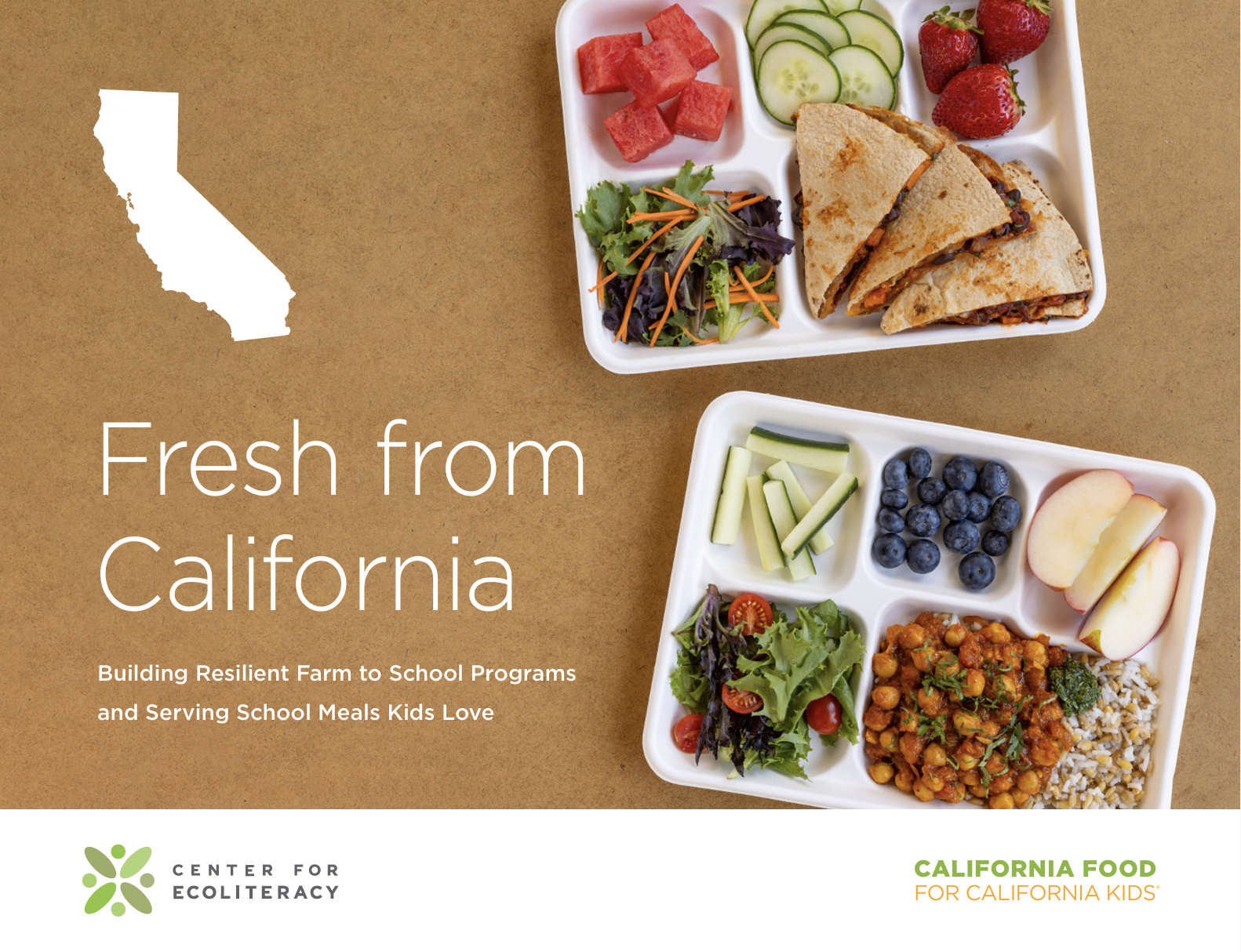
California’s Farm to School initiative, led by the CDFA in partnership with nonprofit leaders such as the Center for Ecoliteracy, is transforming school food systems. Through grants, regional networks, and technical assistance, the program strengthens connections between schools and local producers while advancing climate-smart and culturally relevant food practices, supporting districts to:
|
|
California Environmental Literacy Initiative (CAELI) (2016 to Present) Led by: Ten Strands |
The California Environmental Literacy Initiative (CAELI) is a statewide initiative led by Ten Strands, bringing together county offices, districts, community-based organizations, and state agencies to build a coherent system for environmental literacy and sustainability in California schools. Through workgroups, professional learning communities, and strategic collaborations, CAELI advances environmental literacy, supports district capacity-building, and aligns instruction with sustainability and climate resilience. |
|
(Released in Spring 2025) Partners: Ten Strands and the San Mateo County Office of Education |
Seeds to Solutions™ is a set of free, solutions-oriented, age-appropriate instructional resources on California environmental issues for grades K–12. The open education resources, (released in Spring 2025), include one model three-week unit for each grade level (K-12) that integrates environmental justice and climate literacy through an interdisciplinary approach.
Educators can request a professional learning workshop for their site or district, and/or get real-time support during drop-in office hours. |
|
California Green Ribbon Schools (2014 to Present) Led by: California Department of Education (CDE)
|
The California Green Ribbon Schools (CA-GRS) program, (launched in 2014) advances whole-school sustainability by supporting schools, districts, and county offices of education in reducing environmental impact and costs, improving health and wellness, and strengthening environmental and climate literacy. Through a tiered recognition system, it drives continuous improvement, helping school systems create healthier, more efficient campuses while preparing students to succeed in a changing climate. |
District and County Leadership (Stories from the Field)
While statewide initiatives provide frameworks and guidance, county offices and districts are where implementation comes to life. The Ten Strands Data Initiative for Environmental and Climate Action in California’s TK-12 Schools (2025) shows that many counties, districts, and school sites are already making progress—particularly in energy efficiency, gardens and outdoor learning, waste reduction, and student-led sustainability efforts—demonstrating strong entry points for action. Below are some highlights from the field of where action is taking place and momentum is building.
County-Level Action
The San Mateo County Office of Education (SMCOE) is widely recognized as a statewide leader for regional environmental literacy and sustainability work. Since launching its initiative in 2017, SMCOE has built a dedicated team—including a Green Facilities and Operations Analyst and a Director of Facilities and Sustainable Construction—to support districts with:
- sustainable construction and decarbonization
- green schoolyards and ecological design
- zero-waste programs
- climate resilience planning
- environmental literacy integration
A growing number of county offices (ex: Santa Cruz, San Joaquin, Santa Clara, San Diego, Los Angeles, and others), are beginning to develop similar infrastructure. Collectively, they represent the early backbone of a future regional support system for sustainability and climate resilience in K–12 schools.
District-Level Action
Many districts—large and small—are demonstrating what’s possible when sustainability and climate resilience are integrated into facilities, operations, instruction, and student experience.
For example, some of the larger urban district leaders include:
Los Angeles USD: Advancing 100% clean, renewable energy; expanding green schoolyards; electrifying fleet; integrating climate literacy; investing in energy resilience.
Sacramento City USD: Solar and battery storage expansion, electric buses, campus greening, and robust garden and farm-to-school programs.
Oakland USD: Districtwide Climate Action Plan, decarbonization and electrification efforts, green infrastructure, zero-waste initiatives, and student-led climate projects.
San Francisco USD: Leadership in green building standards, stormwater solutions, school gardens, outdoor learning, and environmental education.
Medium to smaller sized school districts who have participated in the California Green Ribbon Schools program (explore stories here), have become models for whole-school sustainability, implementing exemplary practices in:
- energy efficiency and renewable energy
- drought-tolerant landscaping and school gardens
- green cleaning and indoor air quality
- composting and food waste reduction
- climate-smart food procurement
- outdoor learning environments
- student-led climate and sustainability initiatives
These schools represent accessible, replicable pathways that districts of all sizes can follow.