


















How Improvement, Implementation, and Relational Trust Help Change Take Hold
By Dr. Jennifer E. Garcia
Schools are not short on good ideas.
We know a great deal about effective instruction, student support, attendance, assessment, school culture, and leadership. Districts invest in programs, professional learning, coaching, data systems, and improvement plans, and educators work hard to put those ideas into practice.
Yet still, promising changes often struggle to take hold.
A practice works well in one school and barely gets started in another. Teachers leave professional learning enthusiastic, but six weeks later implementation varies widely. A team identifies a strong change idea, but the schedule, staffing, or existing routines make it difficult to use consistently. Leaders collect data but find that people are reluctant to talk openly about what isn’t working.
When that happens, we often ask whether the idea worked.
Before we decide an idea failed, I think we need to ask a different question: Did we create the conditions that gave the idea a fair chance to work?
For California educators, this challenge is especially relevant in a system that increasingly asks schools and districts to pursue continuous improvement. Identifying what needs to improve is only part of the work. Leaders also have to build the conditions that allow promising changes to take hold in practice, and relational trust supports honest learning along the way.
This challenge is what led me to think more intentionally about three bodies of knowledge that are often discussed separately in education: improvement science, implementation science, and relational trust.
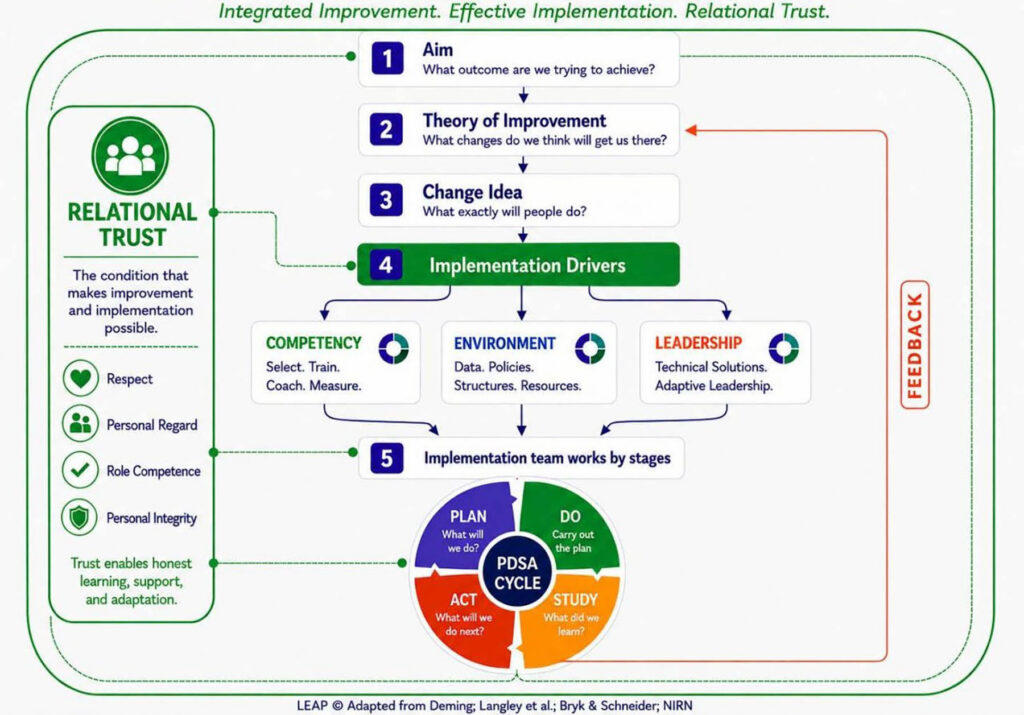
Each brings a different lens. Improvement science helps us learn our way toward better outcomes. Implementation science helps us build the supports and conditions that allow a change to become everyday practice. Relational trust shapes whether people can participate honestly in both. We strengthen our change efforts when we use these approaches together, allowing each to contribute something important to how we understand, support, and sustain change.
Improvement science helps us learn.
Improvement science asks us to begin with the problem rather than the solution. What are we trying to improve? What is producing the current result? Where do we see variation? What change might lead to improvement? How will we know?
Based on the work of W. Edwards Deming, the Model for Improvement developed by Gerald Langley and colleagues, and Anthony Bryk and colleagues, improvement science gives schools a disciplined way to test ideas rather than simply launch them at scale.
Imagine a school concerned about the effectiveness of its intervention block. Too many students are receiving intervention without making enough progress. The quickest response might be to buy a new intervention program. An improvement approach slows the team down long enough to ask what is actually happening.
Are students grouped according to current needs? How often are groups adjusted? What information are teachers using? Does the problem look the same across grade levels?
The team might discover that the bigger problem isn’t the intervention materials at all. Perhaps students remain in the same groups for months because teachers lack a reliable process for reviewing progress data. Now the team has something specific to test.
But identifying a promising change is only part of the work.
Implementation science helps the change become usable.
Suppose the team decides to test a new routine: every two weeks, grade-level teams will review progress-monitoring data, regroup students, and adjust intervention.
It sounds straightforward, but in practice, the questions come quickly.
Do teachers understand the data well enough to make grouping decisions? Do they have common planning time? Is there a clear meeting protocol? Does someone know how to coach struggling teams? Can the schedule accommodate students moving between groups? Do assessments give teachers information quickly enough to use? Who addresses problems when the new routine conflicts with an existing school process?
These details are easy to underestimate, but they can determine whether the change has a fair chance of ever succeeding.
The Active Implementation Frameworks developed through the National Implementation Research Network make this part of change much more visible. Effective implementation requires attention to practitioner competency, organizational supports, leadership, implementation teams, and the stages through which a new practice develops.
Training alone is rarely enough. People may need modeling, coaching, feedback, and repeated practice opportunities. Leaders may need to adjust schedules, clarify roles, allocate resources, or remove competing expectations. Teams may need to identify barriers and solve problems as they emerge.
Improvement science helps us identify and test promising changes. Implementation science asks whether we have built the conditions necessary for people to carry them out well. We need both sets of questions to see the change we strive for.
Relational trust determines what we are able to learn.
Another issue underlies both improvement and implementation: Will people tell us what is really happening?
Return to the intervention example. A teacher has tried the new process for three weeks and is struggling. Can she say, “I still don’t understand how to use these data”? Can teachers tell the principal, “The schedule is making regrouping almost impossible”? Can a coach observe practice and offer feedback without the teacher assuming it will be used in evaluation? Can someone question the team’s original idea for change? Can the team look at disappointing results and get curious rather than defensive?
Improvement depends on accurate information about what is happening. Implementation depends on knowing where people need support and where the system is creating barriers. Both become much harder when people feel they need to protect themselves.
Anthony Bryk and Barbara Schneider’s work on relational trust in schools helps explain why these interactions matter. Their framework highlights respect, personal regard, competence in core role responsibilities, and personal integrity.
Trust does not mean avoiding difficult conversations or lowering expectations. It means building relationships where people can engage in difficult work honestly.
When relational trust is weak, implementation data can become compliance data. Coaching can feel like surveillance. Questions can be interpreted as resistance. People may report what leaders want to hear rather than what leaders need to know.
When trust is stronger, problems can become information. Someone can say, “This part isn’t working.” “I need help.” “We made an assumption that turned out to be wrong.” “The strategy is good, but the way we structured it is creating a barrier.”
Those are exactly the kinds of statements teams need to hear. Relational trust is not something that sits beside the technical work. It shapes the quality of the learning inside it.
Bringing the three together
Improvement science, implementation science, and relational trust bring distinct bodies of knowledge to the conversation of school improvement, but their contributions intersect throughout the work of change. Together, they help us think more fully about what we are trying to improve, what it will take for a change to work in practice, what we are learning along the way, and whether people have the relational conditions needed to engage honestly in that learning.
One way to see their complementary contributions is through the questions they bring to the work:
| Improvement science asks | Implementation science asks | Relational trust supports |
| What are we trying to improve? | What needs to be in place for people to do the work well? | Honest discussion of the problem |
| What is producing the current result? | What barriers in the system affect implementation? | Willingness to surface difficult realities |
| What change should we test? | Is the change clear and usable in practice? | Openness to trying something new |
| What are we learning from the test? | Are people receiving the training, coaching, resources, and leadership support they need? | Candor about where people need help |
| What should we do next? | How do we strengthen and sustain the practice over time? | Productive feedback and shared learning |
The value is not simply in using all three. It is in recognizing how they reinforce one another and work together.
Without enough attention to implementation, a promising change idea may never become reliable practice. Without a disciplined improvement process, a practice may be used consistently without enough learning about whether it is actually improving outcomes. And when relational trust is weak, both can look better on paper than they do in practice because people are less likely to surface problems or uncertainty.
The practical shift is away from a linear assumption: choose the right thing, train people, expect results, but toward a learning process: understand the problem, develop a theory, test a change, build supports, study what happens, surface barriers honestly, adapt, and test again.
Five things you can do tomorrow
Schools don’t need to adopt another framework to start integrating these ideas. A team could start tomorrow with five relatively simple moves.
1. Get specific about what you are trying to improve.
Before talking about programs or strategies, finish this sentence:
We will know things are getting better when…
Name the outcome. Name the students or adults affected. Name what improvement would actually look like. If the team cannot answer that clearly, it is probably too early to discuss solutions.
2. Ask what people will need to make the change work.
Once you identify a change, don’t stop at, “When will we train everyone?” Ask what knowledge and skill people will need, what coaching will be available, what time or resources must be protected, and what current structures might make the change difficult.
This conversation can surface implementation problems before they become implementation failures.
3. Look for variation instead of looking at everything together.
If a strategy seems to work in some classrooms, teams, or schools but not others, don’t immediately conclude that the strategy works or doesn’t. Ask: What is different?
Perhaps one team has a coach. Another has common planning time. One principal has protected the work from competing initiatives. Another school has greater staff turnover. Variation is information about the conditions the change may require.
4. Make one meeting safer for learning.
At your next meeting focused on improvement, change the way you respond when someone identifies a problem. Resist the urge to defend the plan or immediately fix the person.
Try: “What does that tell us about the system?” or “What are we learning from that?” Small leadership responses send powerful signals about whether candor is rewarded or punished. Relational trust is built in moments like these.
5. End with one thing you will learn next.
Do not end the meeting with only a list of tasks. End with a learning question: What do we need to learn over the next two weeks about whether this change is helping?
Then identify what evidence you will examine. That keeps the work from becoming another implementation checklist and reconnects action to learning.
Good ideas need more than enthusiasm.
Schools will continue to encounter good ideas, and that is a good thing.
But our greatest challenge may not be finding the next promising practice. It may be building organizations that know how to learn whether an idea is helping, support people in putting it into practice, and create relationships strong enough to surface what needs to change along the way.
Improvement science gives us a disciplined way to learn. Implementation science helps us create the conditions for change to become practice. Relational trust allows people to engage honestly in both.
The opportunity is to bring these bodies of knowledge together in ways that strengthen how we understand, support, learn from, and sustain change.
Good ideas still matter, but they are only the beginning. To move from a promising idea to sustained change, schools need disciplined learning, effective implementation, and the relational trust that helps people work through learning together.
Jennifer E. Garcia, Ed.D., is founder of LEAP and a School Improvement and Implementation Consultant. She holds a doctorate in school improvement and works with schools and districts to strengthen improvement and implementation. Her work focuses on helping systems move from promising ideas to sustained changes in practice that lead to better outcomes for students.
Selected references
Bryk, A. S., Gomez, L. M., Grunow, A., & LeMahieu, P. G. (2015). Learning to Improve: How America’s Schools Can Get Better at Getting Better. Harvard Education Press.
Bryk, A. S., & Schneider, B. (2002). Trust in Schools: A Core Resource for Improvement. Russell Sage Foundation.
Deming, W. E. (1986). Out of the Crisis. MIT Press.
Langley, G. J., Moen, R. D., Nolan, K. M., Nolan, T. W., Norman, C. L., & Provost, L. P. (2009). The Improvement Guide: A Practical Approach to Enhancing Organizational Performance (2nd ed.). Jossey-Bass.
National Implementation Research Network. Active Implementation Frameworks. Frank Porter Graham Child Development Institute, University of North Carolina at Chapel Hill.