























By Julie Winkel
For every school administrator, the weight of campus safety is a permanent fixture of leadership. While high-profile tragedies dominate the headlines, the statistical reality is nuanced: Less than 1 percent of youth homicides occur on school grounds. However, when contrasted with the fact that firearms became the leading cause of death for children and teens in 2021, our mandate is clear. We do not prepare for the 1 percent reality; we deploy a 100 percent preparation strategy. Behavioral threat assessment and management (BTAM) is not a security drill; it is our primary defensive and supportive architecture to the prevention of violence on our campuses. By shifting the perception of safety conversations from reaction to prevention, we have changed the approach to comprehensive school safety on our campuses. Through building a “Culture of Care,” we moved beyond just reacting to crises to identifying the students who are “crying out” before they “lash out.”
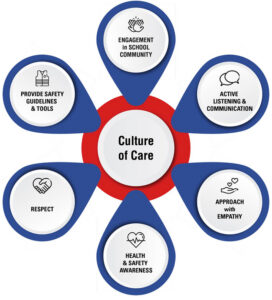
The Culture of Care is grounded in six elements: Engagement in School Community, Active Listening and Communication, Approach with Empathy, Respect, Health and Safety awareness, and to provide safety guidelines and tools. (See Figure 1)
The end of zero tolerance: Why we are shifting gears
The era of Zero Tolerance, sparked by the Gun-Free Schools Act of 1994, relied on a philosophy of “predetermined consequences” (suspension and expulsion) regardless of context. Decades of research now confirm these exclusionary practices do not reduce violence; in fact, they often exacerbate the hopelessness that fuels it. As educational leaders, we must understand the legal elements that have developed over the last five years through legislation and Ed Code that require schools to provide a comprehensive safe school environment through practice. These practices include behavioral threat assessment and management (BTAM) and trauma-informed supports. The changes in law and ed code obligate schools/districts to understand and respond to threats, use positive behavior interventions, trauma informed and restorative practices, bullying prevention, and mental health awareness to support students in crisis exhibiting violent or dangerous behaviors. In the current climate of schools being held to high standards of care for student well-being, districts can no longer lean on a compliance with a checklist, they have to put the compliance into action to truly withhold the standards of which have been given by the state to build a safer school environment for staff and students. BTAM provides the framework to meet this duty by prioritizing “prevention over reaction” and “intervention over exclusion.” This approach identifies the “why” behind a behavior, allowing us to interrupt the pathway to violence through support rather than simple removal.
Safety is a shared responsibility
With the shift of building a Culture of Care, truly supporting a comprehensive safe school environment safety can no longer rest on the shoulders of a single administrator. In many cases the most critical area of a school environment, school safety, is laid upon the job duties of the most in experienced administrator. Knowing school safety is not the most alluring part of the job description of a school administrator, it is still the most important part of providing an environment for students to thrive academically and social emotionally. In addition, there is no section of the administrative credential process that trains you on the scope of what comprehensive school safety looks like on a campus. It is a district’s duty to support the ownership of safety into the hands of all leaders on campus. It must be embraced as a team to fully support ownership of building a positive school culture that supports students safety.
The implementation of BTAM allows the work of prevention to be supported by more than an administrator. The BTAM model of a multidisciplinary team (administrator, mental health associate and school resource officer) showcases how comprehensive school safety should be carried by all adults within the school walls. In addition, if you have multiple people filling these roles, you cannot just have one person trained — every person on campus needs to have the capacity to follow through with supporting school safety from prevention to crisis management.
A high-functioning BTAM team must be multidisciplinary to reduce bias and ensure a holistic view of the student. The Roseville Joint Union High School District (RJUHSD), team integrates:
Administration: Leads the process, coordinates communication, and manages the “Duty to Warn” potential targets.
Mental health associates, school psychologist, school counselor: Provide the clinical core, conducting interviews and assessing mental health variables.
School resource officers (SROs): Serve in a consultative or direct role, especially when risk factors of outside of school activities maybe considered.
Special education experts: Ensure that a student’s disability profile is central to the assessment.
Technology specialists: Assist in reviewing digital “leakage” via social media, search histories, and district-issued devices.
Deciphering the threat
To prevent administrative burnout and “over-warning” the community, the team must distinguish between a student making a threat and posing a threat. Data show that approximately 75 percent of threats are transient (making), which are expressions of temporary frustration rather than intent usually expressed as a joke or figure of speech. A substantive threat (posing) involves planning, substantial thought, or preparation of an act of violence to resolve anger/frustration or personal grievance. BTAM allows inquiry to determine the severity and risk of the threat. Substantive threats include specific, plausible details (method, victim, time), physical evidence (lists, drawings, weapons) often exist which requires protective mitigation to prevent the violent act. These behaviors are observable and allow a multidisciplinary team assess the type of threat the student if concern poses to the target (person, place, group of people). This allows for an opportunity for prevention of a violent act.
The BTAM process is a structured approach to prevention to allow schools to assess the threat and determine interventions to support the student in interrupting their pathway to violence.
To move through the process teams must utilize specific assessment frameworks:
Referral: Concerns are funneled through Aeries, anonymous tips, or staff reports.
Triage: The team sets a low threshold for intervention, treating every report with urgency to determine validity.
Team assessment: This is the clinical “deep dive” where we apply 11 essential questions to analyze the intent, preparation, grievance, targets, protective and risk factors for the subject.
Management plan: Developing immediate and long-term supports to protect targets and the student of concern.
Monitor and support: Ongoing review of the student’s progress and adjustment of interventions.
By moving to a fact-based, systematic process, teams achieve parity in discipline, reducing the disproportionate impact of exclusionary discipline on students of color and those with IEPs. However, the BTAM team does not replace the IEP or 504 team, they must coordinate. Our goal is to provide reasonable modifications (e.g., de-escalation, removing triggers) rather than defaulting to exclusion, which rarely eliminates risk for any student.
Intervention, not just discipline
Documentation is our legal obligation when providing interventions and discipline for a student. In the RJUHSD context, we utilize our student information system to maintain a defensible record:
Pre-referral interventions: Used by staff to note Tier 1 items (academic concerns, parent contact) without a formal office referral.
Referrals to Intervention: Triggers an immediate email to the Intervention Response Team (IRT) and administrators for Tier 2/3 escalation.
FERPA and information sharing: Leaders must not let fear of privacy laws stall safety. The “Health and Safety Emergency Exception” to FERPA allows the disclosure of personally identifiable information without consent during an articulable threat. We share data with those who have a “legitimate educational interest” to protect the community. Every management plan must serve three functions: Mitigating the situation, protecting targets, and providing support through mental health supports and increasing school connectedness when applicable.
A sustainable culture of care
Violence is preventable. When we move away from reactive exclusionary punishment and toward the systematic BTAM model, we build a “Culture of Care” where safety is sustained by trust. By empowering staff to recognize BTAM as an intervention and not a reaction or punishment. Building a school culture through awareness of BTAM encourages students to break the “Code of Silence,” to get support for their peers. As a result, we ensure that help arrives before a crisis begins. Our establishment of BTAM in RJUHSD has had positive effects in perceptions of safety on our campus by all stakeholders (staff, students and parents) according to our increase of score on both the CA Healthy Kids survey and LCAP perception survey over the last three years. The Culture of Care is become a driving force on how we approach all things in RJUSHD.
In the current era of comprehensive school safety, districts have to establish a system of support, training and awareness for their stakeholders around BTAM, focusing on what and how it really does effect your school community and culture. Those actions will allow for ownership for all to be responsible for building a positive school culture and making a safe school environment. When ownership sits with all leaders accountability follows. Our communities and students expect to feel safe at school, but until they actually do, the struggle for higher academic achievement and engagement for all students will suffer. The priority of keeping our students safe will never go away, so changing the perception of safety from reaction to prevention and intervention over exclusion starts with all school/district leaders. The greatest investment we can make to ensure safer schools is through prevention and increasing student connection.
Resource Reference: BTAM Policy, Processes, & Procedure Manual
Julie Winkel is the director of Student Services for Roseville Joint Union High School District and a recognized subject matter expert in Behavioral Threat Assessment and Management (BTAM). She is also a Certified Department of Homeland Security NTER Master Trainer.